Anthropic's Month of Moves: IPO Filing, $965B Valuation, and a Warning About AI Outrunning Itself
In thirty days: a $65B funding round at a near-trillion-dollar valuation, a confidential S-1 filed with the SEC, the restricted launch of Claude Mythos Preview with zero-day exploit capabilities, a SpaceX compute deal, a billing restructure that raised costs for heavy API users, and a public call to build an AI "brake pedal" — issued three days after the IPO filing.

Inaugural digest — covering April 7 through June 6, 2026
The past thirty days at Anthropic looked less like a typical product cycle and more like a compressed corporate biography: a frontier model launched under restricted access, a $65 billion funding round that pushed valuation to near a trillion dollars, a confidential S-1 filed with the SEC, a new billing structure that angered developers, and — two days after the IPO filing — a public call to build a "brake pedal" for AI before it starts improving itself without human oversight. Below is a structured account of each event.
IPO filing and near-trillion-dollar valuation
On May 28, Anthropic closed a $65 billion funding round led by Altimeter Capital, Dragoneer, Greenoaks, and Sequoia Capital, bringing its post-money valuation to $965 billion — surpassing OpenAI and making it the most highly valued startup in the world. 1 CFO Krishna Rao said at the time of the announcement: "This funding will help us serve the historic demand we are seeing." 2
Four days later, on June 1, Anthropic filed a confidential draft S-1 with the Securities and Exchange Commission. The company's official statement was spare: "This gives us the option to go public after the SEC completes its review. The proposed initial public offering will depend on market conditions and other factors." Share count and price are not yet set. 3
By the numbers, the filing arrives at a striking moment: Zacks reported an annualized revenue run rate near $47 billion and projected $10.9 billion in revenue for the quarter ending June 2026 — more than double the $4.8 billion the prior quarter. 4
Investors in the latest round also include Blackstone, Brookfield, D1 Capital Partners, and GIC. 5
The "brake pedal" statement
On June 4 — three days after the S-1 filing — Anthropic published a public statement calling for the AI industry to develop the ability to slow development if models begin to improve themselves without adequate human oversight. CNN described it as a call for an AI "brake pedal." 6
The Wall Street Journal framed it more pointedly: "The $1 trillion startup warns artificial-intelligence models are nearing capability to improve without human intervention." 7
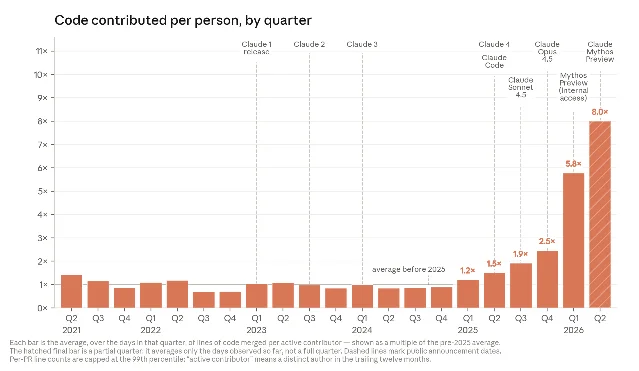
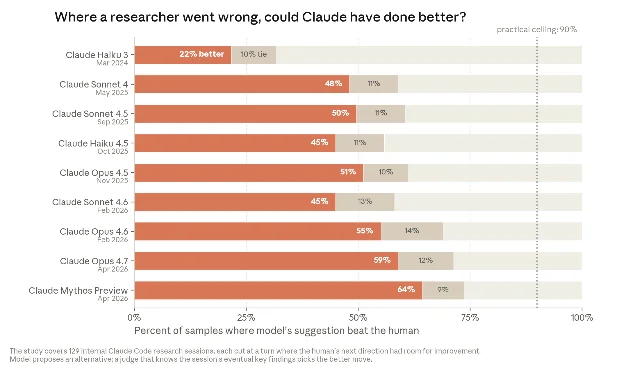
This was not a hypothetical warning. Three days earlier, Anthropic's internal research arm had published data showing that as of May 2026, Claude is responsible for over 80% of the code merged into Anthropic's own codebase — up from single digits before Claude Code launched in February 2025. 8 On the metric of "can the model pick a better next step than a human researcher," Claude Mythos Preview scored 64% in April 2026, up from 51% in November 2025.
Loading content card…
Anthropic's June 4 post announcing the recursive self-improvement research — 16.2 million views within two days.
The engineering data behind the claim:
SiliconAngle was direct about the tension: Anthropic filed for an IPO to raise more capital to push AI capabilities further, then simultaneously called for restraint. 9
Claude Mythos Preview: zero-day vulnerabilities and restricted access
On April 7, Anthropic announced Claude Mythos Preview, its most capable frontier model to date. The model was not released publicly. 10
The cybersecurity capabilities disclosed are notable. Anthropic's red team found that Mythos Preview can identify zero-day vulnerabilities in real software across all major operating systems and web browsers, and that over 99% of the vulnerabilities it found had no existing patches. It can also reconstruct plausible source code from compiled binaries to target closed-source software. The model was made available only to roughly 40 organizations under monitored access through Project Glasswing, with usage priced at 5× the cost of Claude Opus 4.6. Anthropic offered up to $100 million in usage credits to Glasswing partners.
On June 2, Anthropic expanded Project Glasswing to approximately 150 additional organizations across more than 15 countries, focused on finding and fixing vulnerabilities in critical software before malicious actors can exploit them. 11
SpaceX compute deal and developer infrastructure
On May 6 — the same day as the Code with Claude 2026 conference in San Francisco — Anthropic announced a compute partnership with SpaceX. The deal gives Anthropic access to the full capacity of SpaceX's Colossus 1 data center: more than 300 megawatts, or over 220,000 NVIDIA GPUs, available within a month. 12
The announcement listed Anthropic's current compute commitments:
- Up to 5 GW with Amazon (includes ~1 GW of new capacity by end of 2026)
- 5 GW with Google and Broadcom (coming online from 2027)
- $30 billion in Azure capacity through a Microsoft and NVIDIA partnership
- $50 billion in U.S. AI infrastructure investment via Fluidstack
Effective the same day, Anthropic doubled Claude Code's five-hour rate limits for Pro, Max, Team, and Enterprise plans, and removed the peak-hours limit reduction. API rate limits for Claude Opus models were also raised.
Billing restructure: subscriptions no longer cover Agent SDK usage
On May 13, Anthropic announced changes taking effect June 15 to how Claude plan billing works. Starting that date, usage through Anthropic's own tools (claude.ai chat, the official Claude Code CLI) draws from subscription limits as before. Usage through the Agent SDK,
claude -p, or third-party ACP-based tools draws instead from a new monthly credit pool: $20 for Pro, $100 for Max 5×, $200 for Max 20×. Credits bill at full API rates. 13The practical effect: developers using Claude Code through editors like Zed via ACP previously benefited from subscription pricing that was roughly 15–30× cheaper than API rates. After June 15, heavy agent users who exhaust the credit pool pay full API rates for continued access.
What to watch
IPO timeline: The SEC review of the S-1 typically takes 30–60 days. An effective registration would allow Anthropic to set terms and go public — timing is subject to market conditions.
Recursive self-improvement threshold: Anthropic's own data shows Claude Mythos Preview achieving ~52× acceleration on fixed research objectives, up from ~3× for Opus 4 in May 2025. The company's research suggests the open question is not whether AI will begin autonomously setting research directions, but when.
Project Glasswing scale: Expanding from 40 to roughly 190 monitored organizations is a test of whether restricted model access is a viable distribution strategy for dual-use capabilities.
References
- 1Anthropic Hits $965 Billion Valuation, Surpassing OpenAI — WSJ
- 2Anthropic tops OpenAI as world's most valuable startup — law.asia
- 3Anthropic confidentially submits draft S-1 to the SEC — Anthropic
- 4Anthropic IPO 2026 Guide — Zacks
- 5Anthropic moves toward IPO — Virginia Business
- 6Anthropic warns that AI will soon be able to improve itself — CNN
- 7Anthropic Urges Global Pause in AI Development — WSJ
- 8When AI builds itself — Anthropic
- 9After filing for its IPO, Anthropic says we need the ability to slow down AI — SiliconAngle
- 10Claude Mythos: What Does Anthropic's New Model Mean for the Future of Cybersecurity? — Turing AI Institute
- 11Expanding Project Glasswing — Anthropic
- 12Higher usage limits for Claude and a compute deal with SpaceX — Anthropic
- 13What Anthropic's New Claude Billing Means for Zed Users — Zed
Add more perspectives or context around this Post.